
ISLAMABAD: The government has decided to take legal action against the judge who gave a controversial observation in the high treason case against former military ruler Pervez Musharraf.
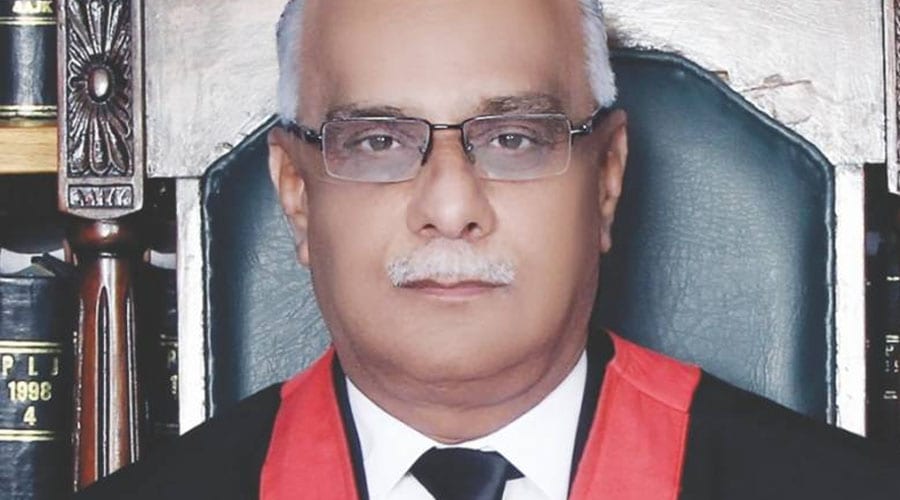
Addressing a press conference, Federal Law Minister Farogh Naseem said that the federal government has decided to file a reference at the Supreme Judicial Council against Justice Waqar Ahmed Seth.
“He has written that we direct all law enforcement agencies to arrest Musharraf and punish him according to the law. He has further written that if he is found dead, his corpse be dragged to D-Chowk and hanged for three days,” said Naseem.
Naseem said that it is incomprehensible to give such an observation, referring Paragraph 66 of the case verdict in which the court ordered law enforcement agencies to hang his body for three days at the D-Chowk if he is found dead.
The law minister said that Justice Waqar was unfit. “By giving such an observation, Justice Waqar has proven that he is mentally unfit,” said Naseem, requesting the Supreme Court to stop the judge from working.
READ MORE: DG ISPR critcises detailed verdict in Musharraf treason case
The law minister raised a question on the judge’s ability to discharge justice in light of his observation. “He is incompetent and should be restrained from discharging any administrative or judicial duties immediately. We will move this reference with the Supreme Judicial Council very soon,” he said.
Special Assistant to the Prime Minister on Accountability Shahzad Akbar said that he felt ashamed after reading the controversial paragraph. “My head hung in shame after reading the detailed verdict,” he said, adding that the judge of the special court has also taken an oath to obey the law.
READ MORE: Musharraf verdict received with ‘pain and anguish’: DG ISPR
Akbar said that the verdict had flouted international laws. He said that it was important to find out how the controversial paragraph was inserted in the verdict. He said the mode and manner in which this trial was conducted is suspicious, and a trial in absentia cannot be conducted.
He said that the verdict had made Pakistan a laughing stock in front of the whole country. He added that the judge had spoiled the entire case by giving the judgment. Akbar said that the government had reservations about how the trial was conducted, adding that a fair trial should have been held.
ADVERTISEMENT