

Two photographs circulating widely in Pakistan this week have become shorthand for a long-running public grievance: that the law bends one way for activists and another for the connected. The images, juxtaposed in countless posts, contrast the May 5-6 detention of 75-year-old Aurat March activist Sheema Kermani with a routine-looking courtroom scene involving a woman described online as “drug queen Anmol Pinky.”
The result is a viral case study in optics — and in the deep skepticism many Pakistanis harbor toward the even-handedness of law enforcement.
Right frame: The activist
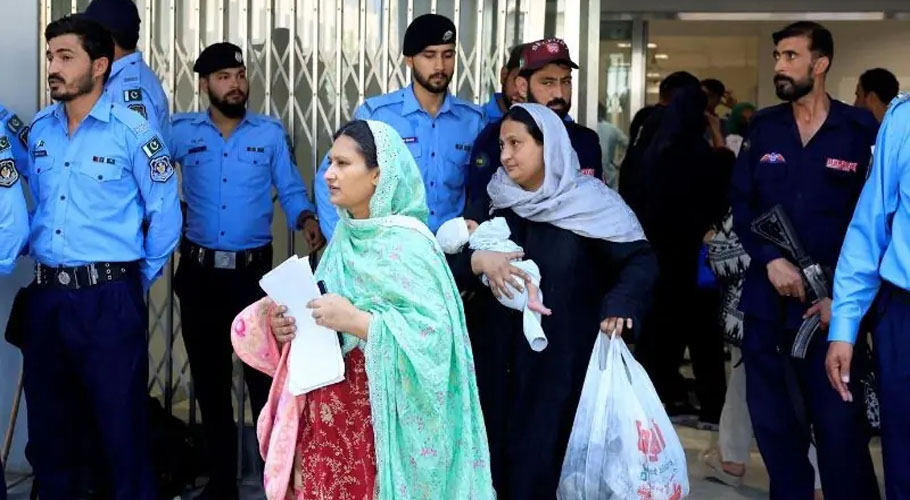
Sheema Kermani — classical dancer, women’s rights campaigner, and a visible face of Aurat March — is seen surrounded by female police officers in niqabs outside Karachi Press Club. Video from the scene shows her gesturing and speaking as officers escort her.
Kermani and other activists were attempting to hold a press conference to demand a No Objection Certificate (NOC) for Aurat March activities. Police briefly detained several activists, including Kermani, before releasing them on orders from “higher authorities.” The incident triggered immediate backlash online. Sindh authorities later confirmed three officers were suspended pending inquiry.
Left frame: Anmol Pinky
The contrasting image shows a woman seated calmly in what appears to be a clerk’s office in a Karachi court. A court official writes at a desk nearby. Water bottle on the table. No visible restraints.
In the viral meme, the woman is labeled “drug queen Anmol Pinky.” The captioning frames the scene as evidence of “leniency” — the procedural calm afforded to individuals perceived to have wasta, or elite connections.
THE CORE OF THE PUBLIC ARGUMENT
The juxtaposition has been weaponized by critics to allege a double standard:
|
Scenario |
Police Response (as perceived online) |
Public Interpretation |
|---|---|---|
|
Elderly activist seeks NOC for press conference |
Physical escort, detention, suspension of officers after outcry |
Heavy-handed policing of dissent and women’s rights advocacy |
|
High-profile accused in court setting |
Seated, uncuffed, bureaucratic routine |
Deference and procedural ease for the well-connected |
THE COUNTERPOINT: CONTEXT AND COMPLEXITY
Police officials and legal analysts caution against reading systemic policy into two snapshots. Key caveats:
- Legal requirements differ: Public gatherings require NOCs under Section 144 and other local orders. Police cite crowd-control mandates when denying or dispersing unpermitted events. Court appearances, by contrast, are governed by judicial procedure — accused persons are routinely uncuffed in courtrooms unless deemed a flight or security risk.
- Incident-specific factors: Threat assessments, prior intelligence, and on-ground dynamics shape police response. A press conference near a sensitive location may trigger a different SOP than a scheduled court hearing.
- Due process cuts both ways: The accused in court is presumed innocent and entitled to dignity in proceedings. The activist is entitled to free expression and assembly, subject to lawful restrictions.
Still, the suspensions of officers after Kermani’s detention suggest even the department acknowledged a breach of proportion. The inquiry’s findings have not yet been made public.
WHY THE NARRATIVE STICKS
The Kermani incident landed during a charged moment for women’s rights organizing in Pakistan. Aurat March has faced NOC hurdles, legal challenges, and public backlash annually since 2018. For supporters, the image of a 75-year-old artist being physically managed by police became symbolic of state hostility to feminist dissent.
The courtroom image, stripped of case details, became its foil — a visual proxy for impunity. Whether accurate to the specific case or not, the pairing confirmed a belief many already held: that status, not statute, dictates treatment.
THE STAKES FOR SINDH POLICE
Optics are operational. When the public believes enforcement is selective, compliance erodes and legitimacy suffers. Sindh Police have repeatedly stated commitments to professionalism and impartiality. But in the age of viral video, perception is often policy.
The department now faces a familiar test: investigate transparently, communicate clearly, and demonstrate consistency. Without that, two photos will continue to do what lengthy reports cannot — define the story.
BOTTOM LINE
Individual incidents rarely prove systemic bias on their own. But patterns of differential treatment — real or perceived — corrode public trust faster than any single FIR.
The question raised by these two frames isn’t just about Sheema Kermani or Anmol Pinky. It’s the question Sindh Police must answer for every citizen watching:
Is the law a shield for all, or a tool that changes shape depending on who’s holding it?