
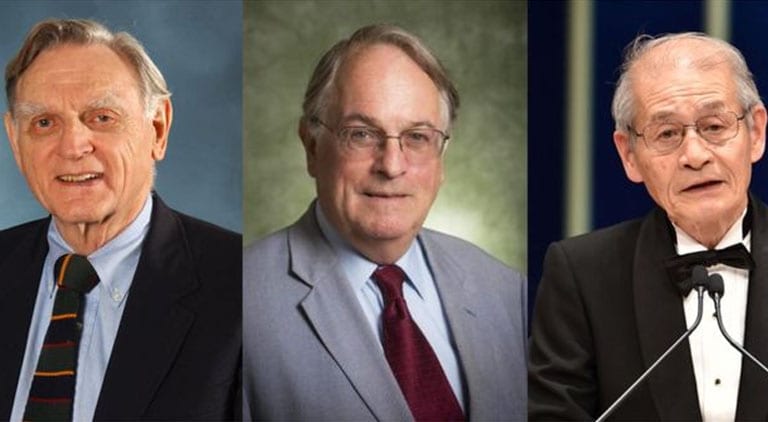
STOCKHOLM: Scientists John Goodenough, Stanley Whittingham and Akira Yoshino won the 2019 Nobel Prize for Chemistry on Wednesday for the development of lithium-ion batteries, an important technology in enabling the world to move away from fossil fuels.
American Goodenough, at 97, becomes the oldest winner of a Nobel prize. He shared the award equally with Whittingham from Britain and Yoshino of Japan.
“This rechargeable battery laid the foundation of wireless electronics such as mobile phones and laptops,” the Royal Swedish Academy of Sciences said in a statement on awarding the 9 million Swedish crown ($906,000) prize.
“It also makes a fossil fuel-free world possible, as it is used for everything from powering electric cars to storing energy from renewable sources.”
READ MORE: Nobel Prize in physics awarded for cosmology, exoplanet research
Whittingham developed the first functional lithium battery in the early 1970s. Goodenough doubled the battery’s potential in the following decade and Yoshino eliminated pure lithium from the battery, making it much safer to use.
Olof Ramström, from the Nobel Committee, said lithium-ion batteries had “enabled the mobile world”. The lithium-ion battery is a lightweight, rechargeable and powerful battery that is used in everything from mobile phones to laptops to electric cars.
The Nobel Committee said the device “created a rechargeable world”. It added: “Lithium-ion batteries are used globally to power the portable electronics that we use to communicate, work, study, listen to music and search for knowledge.”
Göran K Hansson, secretary-general of the Royal Swedish Academy of Sciences, where this year’s awards were announced, said their development enabled “a more sustainable world”. In addition to their use in electric vehicles, the rechargeable devices could also store significant amounts of energy from renewable sources, such as solar and wind power.
The foundation of the lithium-ion battery was laid during the oil crisis of the 1970s. M Stanley Whittingham, 77, who was born in the UK, worked to develop energy technologies that did not rely on fossil fuels. He discovered an energy-rich material called titanium disulphide, which he used to make a cathode – the positive terminal – in a lithium battery.
READ MORE: Doctors trio win Nobel Medicine Prize for oxygen research
Whittingham, who is based at Binghampton University in Vestal, US, made the anode, the battery’s negative terminal, from metallic lithium – which has a strong preference for releasing electrons. This made it very suitable for use in batteries. This resulting device was able to release just over two volts, but the metallic lithium made it explosive.
John B Goodenough, who is American but was born in Germany, predicted that the cathode could be improved if it was made from a metal oxide, rather than a sulphide.
In 1980, after searching for the ideal material, Goodenough, who is a professor at the University of Texas, Austin, used cobalt oxide to boost the lithium battery’s potential to four volts. With Goodenough’s cathode as a basis, Akira Yoshino, 71, created the first commercially-viable lithium-ion battery in 1985.
The prizes for achievements in science, literature and peace were created and funded in the will of Swedish dynamite inventor and businessman Alfred Nobel and have been awarded since 1901. The Nobel prizes for medicine and physics were awarded earlier this week. The awards for literature, peace and economics will be announced in the next few days.