
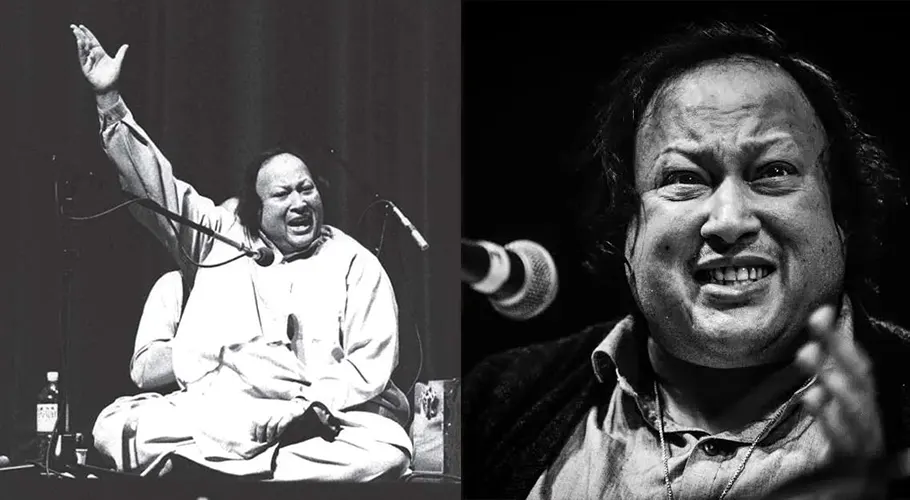
FAISALABAD: The 78th birth anniversary of legendary Pakistani singer and qawwali maestro Ustad Nusrat Fateh Ali Khan is being observed on October 13, celebrating the life and legacy of an artist whose extraordinary voice helped introduce South Asian Sufi music to audiences around the world.
Renowned for his powerful vocals, remarkable musical range and soulful renditions of Sufi poetry, Nusrat Fateh Ali Khan remains one of the most influential figures in the history of qawwali. Decades after his death, his music continues to resonate with listeners across generations and cultures.
Born on October 13, 1948, in Faisalabad, Nusrat Fateh Ali Khan belonged to a family with a long-standing tradition of qawwali. His father, Ustad Fateh Ali Khan, and his uncle, Ustad Mubarak Ali Khan, were prominent qawwals of their time. Growing up in this musical environment, he developed a deep passion for music and gradually established himself as an exceptional performer.
Initially, his father hoped that he would pursue a career outside music. However, Nusrat’s strong interest in the art eventually led him to embrace the family’s musical heritage. Following his father’s death, he received further training in music and qawwali from his uncle, Ustad Mubarak Ali Khan. After his uncle’s death in 1971, Nusrat assumed leadership of the family qawwali ensemble and began shaping the tradition with his distinctive style.
Taking Qawwali to the World
Nusrat Fateh Ali Khan’s artistry extended far beyond traditional qawwali. He blended Sufi poetry, ghazals, classical influences and contemporary musical elements with remarkable skill, attracting audiences from diverse linguistic and cultural backgrounds.
His performances frequently explored themes of divine love, spirituality, devotion and human emotion. Through his music, he helped bring the message of Sufi poets to audiences across continents, demonstrating how music can transcend linguistic and geographical boundaries.
His international popularity grew significantly during the 1980s. Through performances in Europe, the United States, Japan and other countries, he introduced international audiences to the rich traditions of South Asian qawwali.
His collaboration with renowned British musician Peter Gabriel marked an important milestone in his international career. By experimenting with elements of Western music while preserving the essence of traditional qawwali, Nusrat helped create new musical possibilities and broadened the genre’s global appeal.
Timeless Qawwalis and Memorable Songs
Many of Nusrat Fateh Ali Khan’s celebrated qawwalis continue to enjoy widespread popularity in Pakistan and abroad. Among his best-known performances are Dam Mast Qalandar, Tum Ek Gorakh Dhanda Ho, Yeh Jo Halka Halka Suroor Hai, Haq Ali Ali, Mera Piya Ghar Aaya and Rang.
Songs such as Meri Zindagi Hai Tu, Tere Bin Nahin Lagda and Afreen Afreen have also helped preserve his popularity among successive generations of listeners.
One of the defining features of his singing was his extraordinary ability to sustain musical intensity, maintain intricate rhythms and deliver extended performances with remarkable vocal power. His live concerts often left audiences captivated by the energy and emotional depth of his voice.
Nusrat also made significant contributions to film music. In addition to working on Pakistani productions, he composed music and performed songs for Indian films and contributed to international film soundtracks. His distinctive musical style influenced numerous singers, composers and producers across the South Asian entertainment industry. His work has continued to inspire reinterpretations and adaptations long after his death.
International Recognition and an Enduring Legacy
In recognition of his contributions to Pakistani music, Nusrat Fateh Ali Khan received the Pride of Performance award in 1987. He also earned international recognition throughout his career, while several of his albums received Grammy Award nominations.
His extensive discography, including more than 125 recorded qawwali albums, reflected the extraordinary scale of his musical output and enduring popularity.
Nusrat Fateh Ali Khan died on August 16, 1997, at the age of 48. However, his voice continues to reach audiences worldwide, and his influence remains evident in contemporary music.
His contribution helped transform qawwali from a traditional South Asian musical form into a genre recognised and appreciated by international audiences. By combining the spiritual depth of Sufi poetry with an innovative musical approach, he created a legacy that continues to bridge cultures and generations.
His 78th birth anniversary offers an opportunity to remember an artist who devoted his life to music and brought the richness of South Asian musical traditions to the global stage.
Today, Nusrat Fateh Ali Khan remains a source of inspiration for emerging singers, musicians and music enthusiasts. His powerful voice, timeless compositions and devotion to his art ensure that the legacy of the man widely celebrated as the Emperor of Qawwali will endure for generations to come.