
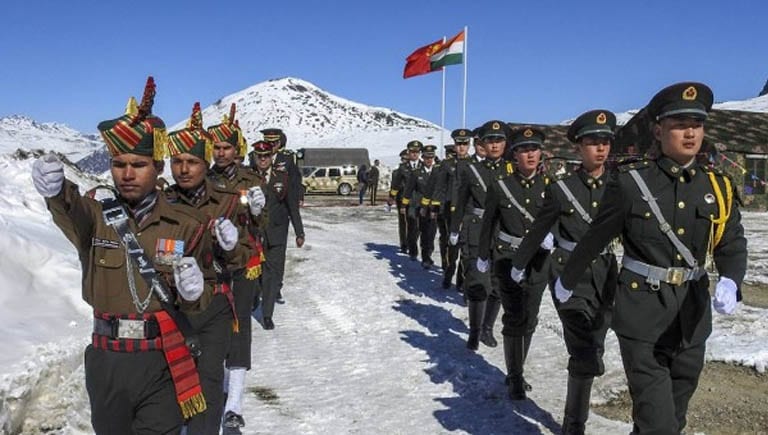
NEW DELHI: India and China agreed to ease tensions at their disputed Himalayan border but continued to trade blame for a clash that left at least 20 Indian soldiers dead.
The foreign ministers of both countries spoke by telephone to urge restrain after a high-altitude violent face-off between troops.
The call between Chinese Foreign Minister Wang Yi and India’s Subrahmanyam Jaishankar as India reportedly deployed paramilitaries to the area of the skirmish high in the Ladakh region.
China has refused to confirm if it suffered any casualties in the first deadly clashes at the border in decades, although Indian media claimed there were casualties on both sides.
The Chinese foreign ministry said in a statement that Wang demanded “India conduct a thorough investigation” and punish those responsible.
“The Indian side must not misjudge the current situation, and must not underestimate China’s firm will to safeguard its territorial sovereignty,” it added.
READ MORE: 20 Indian soldiers killed in clashes with Chinese troops
India’s foreign ministry said Jaishankar conveyed the protest of his government. He warned that “this unprecedented development will have a serious impact on the bilateral relationship” and urged Beijing to “take corrective steps”.
The two ministers also sought to de-escalate tensions. China said both sides agreed to “cool down the situation on the ground as soon as possible”.
India’s foreign ministry said the two sides would implement a previously agreed disengagement, and “neither side would take any action to escalate matters”.
The incident, which took place Monday in the Galwan valley area dominated Indian news channels and inflamed social media in both countries.
The clashes reportedly involved intense hand-to-hand fighting but no gunfire, An Indian army official told a news agency there were violent hand scuffles. Many of these killed appear to have been punched or shoved off a ridge onto rocks and into an icy river below.
READ MORE: 3 Indian soldiers killed in violent clash with Chinese troops
Postmortem examinations on some of those killed showed that the primary reason for death is drowning and it looks like they fell from a height into the water because of head injuries
The United States has said it was hoping for a peaceful resolution and the UN called for maximum restraint. Russia welcomed news of subsequent peaceful contacts between the two neighbours.
India and China have never even agreed on the length of their frontier. They fought a brief war in 1962 and deadly clashes followed in 1967, but the last shot fired was in 1975 when four Indians died.
The recent uptick in tensions began in early May, when several Indian and Chinese soldiers were injured in a clash involving fists and stone-throwing.
The relationship was strained when India revoked the semi-autonomous status of Kashmir and split Ladakh into a new administrative territory.
ADVERTISEMENT