

ISLAMABAD / BARCELONA: Thousands of Pakistanis seeking consular services are reportedly falling prey to an extortionate “agent mafia” operating around European foreign missions in Islamabad, with applicants charged up to Rs1.5 million simply to secure a visa appointment slot.
The alleged illicit buying and selling of appointments—most prominently surrounding the Spanish Embassy in Islamabad—has sparked severe distress among citizens and overseas diaspora members, who describe the situation as a long-running, systematic exploitation of visa applicants.
According to reports circulating among media circles and affected applicants, intermediary agents have hijacked online booking portals to create artificial slot shortages. The slots are then resold at exorbitant prices, ranging from Rs600,000 to Rs1.5 million per booking.
Confirming the trend, journalist Awais Hameed stated that a close acquaintance was recently forced to pay Rs600,000 to an intermediary merely to obtain a basic consular appointment.
Broader European footprint
Public outrage following initial reports revealed that the racket is not isolated to the Spanish mission alone. Several applicants and community members disclosed that similar illegal booking networks are exploiting appointment systems for other European missions in the federal capital, including the embassies of Germany and The Netherlands.
Key Figures at a Glance
150,000+ — Estimated Pakistani nationals residing in Spain.
> 831 million — Annual remittances sent to Pakistan by the diaspora in Spain.
> Rs600k – Rs1.5m — Amount extorted by agents per appointment slot.
The systemic bottleneck disproportionately affects the Pakistani community residing in Western Europe. Over 150,000 Pakistanis living in Spain send approximately $831 million in remittances back home annually. However, families attempting to join their relatives or process essential documentation face months of delays, financial drain, and emotional distress due to the compromised scheduling system.
Calls for crackdown and reform
Community members and observers attribute the crisis to a dual failure: local law enforcement’s inability to penalize Pakistani agents sabotaging the system, and foreign diplomatic missions’ reluctance to modernize or secure their booking infrastructure against automated scraping tools.
Critics argue that local intermediaries have effectively taken the administrative mechanism hostage, urging Pakistani authorities—specifically the Federal Investigation Agency (FIA)—to initiate a nationwide crackdown against illegal visa agents. Simultaneously, calls are mounting for diplomatic missions to implement stricter identity verification protocols to prevent bulk appointment hoarding.
Barcelona summit outlines action plan
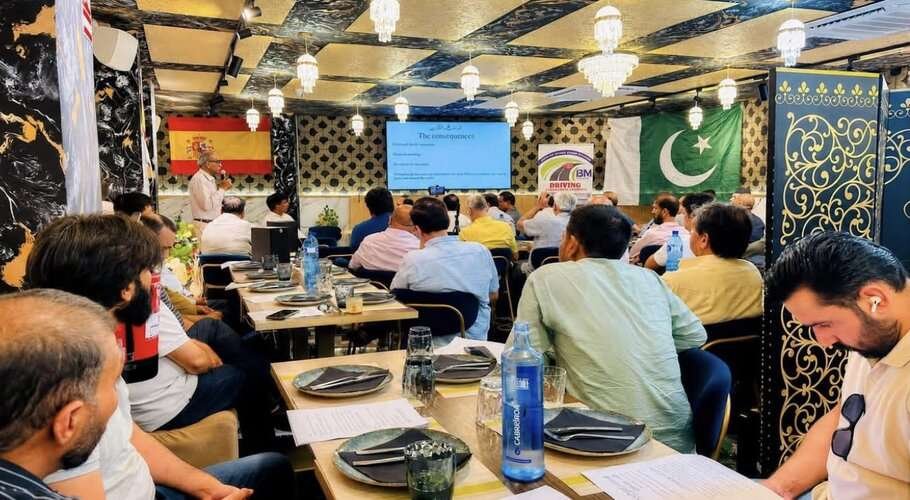
In response to the growing grievances, an extraordinary consultative meeting was convened in Barcelona to formulate a joint strategy to address the crisis.
Hosted by prominent community figure Raja Mazhar Hussain alongside former Pakistani diplomat Syed Ayaz Hussain Shah, the meeting brought together diaspora representatives, organizational leaders, and civic figures.
Participants held detailed deliberations on the structural flaws enabling the racket, outlining a unified action plan to engage both the Ministry of Foreign Affairs (MoFA) in Islamabad and relevant European foreign offices to dismantle the agent ecosystem and restore transparent, fee-free access to consular services.