

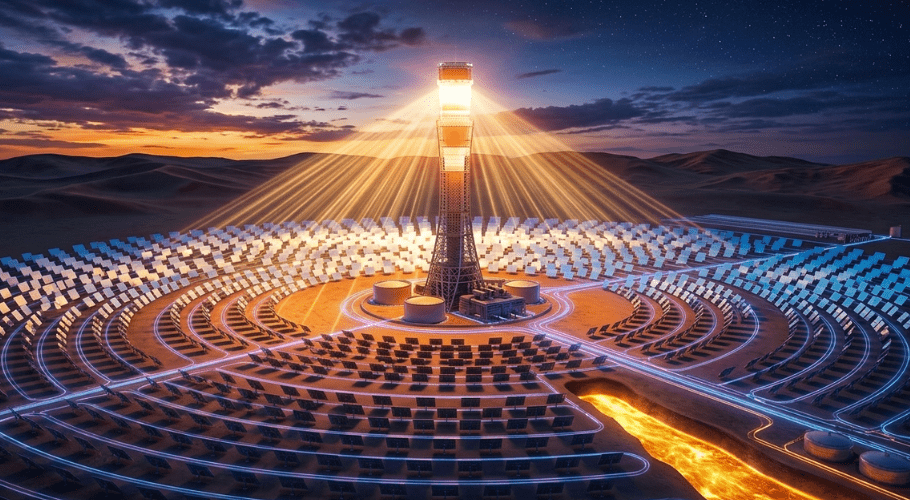
BEIJING: China has brought into operation a large-scale concentrated solar thermal power plant in the Gobi Desert, featuring more than 10,000 computer-controlled mirrors that focus sunlight onto a central tower to generate high-intensity heat and electricity.
According to details, the facility uses heliostats—each roughly the size of a king-sized bed—which continuously track the sun and reflect its rays onto a receiver mounted atop a 200-metre-high tower. The concentrated solar energy is capable of raising temperatures above 1,000°F, enabling the production of steam to drive turbines and generate electricity.
The plant, located in the Qinghai region, produces around 50 megawatts of continuous power, sufficient to supply electricity to approximately 100,000 households. Unlike conventional solar panels, the system stores thermal energy using molten salt heated to around 540°C, allowing electricity generation to continue for up to 15 hours after sunset.
Officials and engineers say the project is designed to operate in extreme conditions, where winter temperatures can drop below minus 30°C and frequent sandstorms affect visibility and maintenance operations.
Chinese authorities are reportedly planning next-generation upgrades, including dual-tower systems and larger facilities expected to deploy between 20,000 and 27,000 mirrors by 2026–2027. These developments are aimed at improving efficiency and scaling up output significantly.
Energy experts say the technology represents a shift in renewable power strategy by addressing one of the biggest challenges in clean energy—storage and consistent base-load electricity supply. The molten salt system allows heat to be stored and used later, making it possible to generate electricity even during nighttime hours.
The project is also being viewed as part of China’s broader energy transition strategy, which includes solar, wind, hydro, nuclear, hydrogen, and experimental fusion technologies, alongside continued coal usage to maintain grid stability.
While the system offers advantages such as reduced reliance on rare materials compared to photovoltaic panels, it also faces challenges, including high installation costs, water usage in desert environments, efficiency limitations, and maintenance requirements due to dust accumulation on mirrors.
China is expected to expand similar solar thermal installations in other desert regions as part of its long-term goal to increase renewable energy capacity and reduce carbon emissions.