
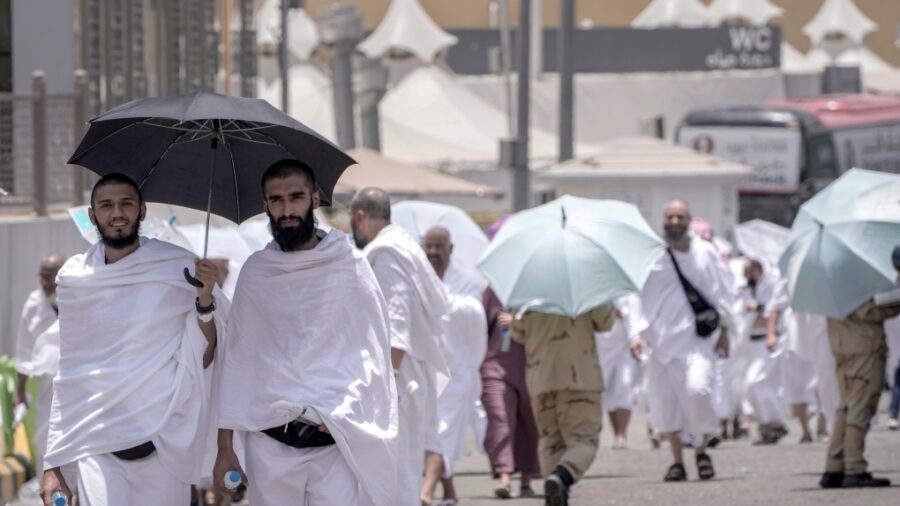
More than a million Muslims are gathering in Makkah for the Hajj pilgrimage overshadowed by the Middle East war, as animosity smoulders across the region despite a fragile ceasefire.
This year’s rites, drawing worshippers from across the Islamic world including Iran, follow waves of Iranian attacks on targets in Saudi Arabia and its Gulf neighbours.
Saudi officials are keen to keep conflict far from the minds of visitors, who have travelled long distances for one of the world’s biggest annual pilgrimages.
But for Fatima, a 36-year-old German housewife travelling with her family, “there was no second thought” about coming to Makkah, Islam’s holiest city.
“We know we are at the safest place in the world,” she told AFP.
The Hajj, one of the five pillars of Islam, must be performed at least once by all Muslims with the means.
As of this week, more than 1.2 million pilgrims had arrived in Saudi Arabia for the multi-day pilgrimage starting Monday, officials said.
– No flags, no chanting –
The Hajj has been a point of tension in the past between Riyadh and Tehran, with repeated outbreaks of violence and unrest involving Iranian visitors.
In the years following Iran’s 1979 Islamic revolution, Saudi authorities accused Iranian pilgrims of triggering stampedes and other violence, while also chanting political slogans — an act seen as taboo by the religious establishment in Makkah.
A Saudi state broadcaster this week posted a warning from the interior ministry saying any chanting or raising political or sectarian flags were strictly prohibited during the Hajj.
The last major dispute erupted in 2015, when 464 Iranians were among 2,300 pilgrims killed in a stampede — one of the Hajj’s biggest tragedies — prompting accusations between Riyadh and Tehran.
Relations were severed a year later after protesters attacked Saudi Arabia’s embassy in Tehran and consulate in the northwestern city of Mashhad, following Riyadh’s execution of Shiite cleric Nimr al-Nimr.
No Iranian pilgrims were allowed that year, as the two sides were unable to organise a protocol for them to attend.
Experts, however, said authorities would do their utmost to prevent any unrest from rattling this year’s pilgrimage.
“Saudi Arabia and Iran have kept their political engagement open” despite the war, said Umer Karim, an expert on Saudi foreign policy.