

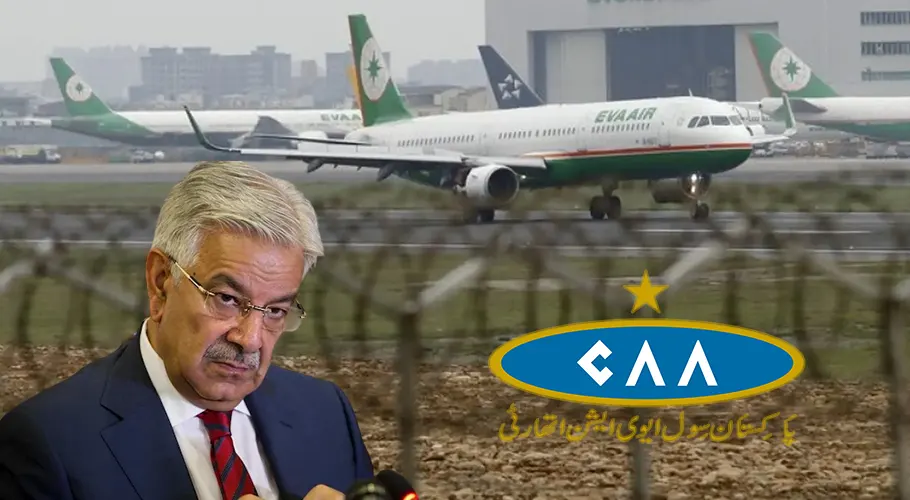
ISLAMABAD: Pakistan has reportedly reopened its airspace to Taiwanese airlines after a brief disruption, amid conflicting accounts over whether Islamabad had imposed restrictions on flights from Taiwan in line with China’s “One China” policy.
While international media reports suggested that Pakistan had barred Taiwanese airlines from using its airspace, Pakistan’s Civil Aviation Authority (CAA) and Foreign Office rejected the reports. Taiwan, however, said Pakistan had temporarily closed its airspace to Taiwanese passenger and cargo flights before reopening it.
According to Bloomberg, Pakistan’s Civil Aviation Authority has granted EVA Airways Corporation and China Airlines Ltd permission to use Pakistani airspace from October 28 to March 27.
How Did Reports of the Ban Emerge?
According to Bloomberg, Defence Minister Khawaja Asif said Pakistan’s aviation division followed China’s “One China” policy, under which only airlines from mainland China were permitted to fly over Pakistan.
The remarks attributed to Asif prompted reports that Pakistan had closed its airspace to Taiwanese airlines, with some media outlets describing the move as a global first.
However, Pakistan’s Foreign Office dismissed the reports, saying misinformation had circulated about the issue.
A spokesperson for the Pakistan Civil Aviation Authority also described the reports as “fake news” in comments to a news outlet, adding that the authority did not know whether the defence minister had made the reported remarks.
According to the CAA spokesperson, Pakistan had not closed its airspace to Taiwan.
Taiwan offered a different account. Deputy Foreign Minister Chen Ming-chi told Agence France-Presse (AFP) that Pakistan had temporarily closed its airspace to Taiwanese passenger and cargo flights before reopening it.
Chen also expressed suspicion that China may have been behind the move. However, no conclusive evidence establishing Beijing’s involvement was cited in the available reports.
Why Did Taiwanese Airlines Change Their Flight Routes?
Flight-tracking data from Flightradar24 indicated that the two Taiwanese airlines stopped using Pakistani airspace from October 25.
According to the data cited in the reports, 14 flights operated by the two airlines crossed Pakistani airspace on October 24. In the following days, at least a dozen flights travelling between Asia and Europe reportedly changed course and flew over Russian airspace instead.
For example, a China Airlines flight from Taipei to Rome on October 24 took a route over Russia rather than following its previous path through India, Pakistan and Turkmenistan.
The reported changes forced some flights to take longer routes, potentially increasing journey times and operating costs.
Why Could the Airlines Face Higher Costs?
For airlines, choosing a flight route involves more than simply calculating the distance between two destinations. Access to national airspace, weather conditions, security considerations, flight permissions and fuel costs all influence route planning.
If Taiwanese airlines cannot use Pakistani airspace, they may need to take alternative routes to reach European destinations.
Longer routes generally mean aircraft spend more time in the air and consume more jet fuel. They can also affect crew working hours, flight schedules and other operating expenses.
However, the available information does not provide a verified estimate of the additional costs or any financial losses incurred by the airlines.
What Is China’s ‘One China’ Policy?
China’s “One China” policy is central to understanding the diplomatic sensitivities surrounding the issue.
Beijing considers Taiwan part of its territory and opposes Taiwanese independence. Pakistan supports Beijing’s position and recognises the People’s Republic of China as the sole legitimate government of China, maintaining that Taiwan is part of China.
Pakistan and China established diplomatic relations in 1951 and have since developed close political, economic and strategic ties. Islamabad maintains limited unofficial relations with Taiwan and does not support its formal independence.
Taiwan, meanwhile, has a population of approximately 23 million people and operates its own government and democratic electoral system. Its government rejects Beijing’s sovereignty claims and governs the island independently in practice, although Taiwan is not formally recognised as a sovereign state by most countries.
Does China Allow Taiwanese Airlines to Use Its Airspace?
According to Bloomberg, China allows Taiwanese airlines to use its airspace.
This detail made the reports about Pakistan’s alleged restrictions particularly significant, as the reported move appeared to go further than China’s own approach to Taiwanese airlines.
However, differing statements from Pakistan’s Civil Aviation Authority and Foreign Office, remarks attributed to the defence minister, and Taiwan’s account have left questions about the nature of the restrictions and the circumstances surrounding them.
What Is the Current Situation?
According to the available reports, Taiwanese officials confirmed that Pakistan had temporarily closed its airspace to Taiwanese flights before reopening it. Pakistan’s Civil Aviation Authority, however, denied that the airspace had been closed.
Bloomberg reported that EVA Airways Corporation and China Airlines Ltd had been granted permission to use Pakistani airspace from October 28 to March 27.
The central issue remains the discrepancy between Pakistan’s official denials and Taiwan’s account of a temporary closure. Although changes to Taiwanese flight routes and the subsequent reopening of Pakistani airspace have been reported, the precise circumstances behind the restrictions and any possible Chinese involvement remain disputed.
The episode should therefore be understood as a contested, apparently short-lived airspace issue rather than conclusive evidence of a permanent Pakistani ban imposed under China’s “One China” policy.


