
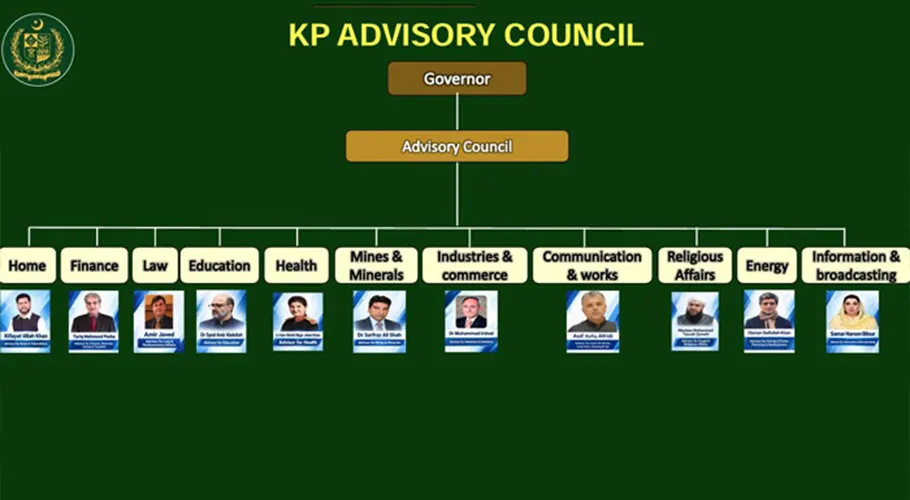
ISLAMABAD: The federal government has established an 11-member Advisory Council to assist in managing the administrative affairs of Khyber Pakhtunkhwa following the imposition of an emergency and Governor’s Rule under Articles 232 and 234 of the Constitution. It has also formally ordered the establishment of Area Development Secretariats (ADS) in designated districts to oversee security, governance and development matters.
Order No. 1/2026 Comes into Effect
Government Order No. 1/2026 came into immediate effect on October 11, 2026, in accordance with the constitutional proclamations issued on the same date.
Under the new administrative arrangement, the Governor of Khyber Pakhtunkhwa will conduct provincial affairs on behalf of the federal government, with assistance from the newly established Advisory Council.
Sanaullah Advocate has also been appointed as the new Advocate General of Khyber Pakhtunkhwa.
Members of the 11-Member Advisory Council
The council, chaired by the Governor of Khyber Pakhtunkhwa, comprises the following individuals:
Tariq Mahmood Pasha
Dr Amir Abdullah
Lieutenant General (Retd) Nigar Johar
Samar Bilour
Dr Sarfaraz Ali
Amir Javed
Dr M. Irshad
Kifayatullah
Tayyab Qureshi
Usman Saifullah Khan
Asif Rafiq
Area Development Secretariats Ordered for Designated Districts
The federal government has directed the immediate establishment of Area Development Secretariats in designated districts to improve security, governance and public welfare. These secretariats will operate under the supervision of the Area Representative and Development Council.
The designated areas include Dera Ismail Khan, Tank, Lakki Marwat, Bannu, Bajaur, Mohmand, Khyber, Kurram, Orakzai, North Waziristan, and Upper and Lower South Waziristan.
Administrator to Oversee Provincial Departments and Law Enforcement
Under the new arrangement, the Additional Chief Secretary of Khyber Pakhtunkhwa for the designated districts will head the secretariat and serve as administrator for the listed areas.
All provincial departments and law enforcement agencies operating in these districts will function under the administrator’s administrative and operational control.
The administrator will have powers relating to governance, security, the allocation of development funds and the issuance of directions to law enforcement agencies, including police and military authorities.
According to the official order, directives, notifications and actions issued by the administrator in the designated districts will carry the same constitutional and legal status as those issued by the provincial government under normal circumstances.