
SAN FRANCISCO: Tesla, the US-based electric vehicle manufacturer, has unveiled its next-generation Roadster sports car, showcasing claimed features including rocket-style thrusters, a specialised suction system and extraordinary acceleration. However, questions remain over the vehicle’s practical usability, safety and real-world performance.
Tesla first introduced the concept of the next-generation Roadster in 2017. Nearly nine years later, commercial production has yet to begin. Meanwhile, other manufacturers have launched advanced electric sports cars and set new performance records, intensifying competition in the electric hypercar market.
How Can the Roadster Drive Upside Down?
During the demonstration, the Roadster was shown climbing vertically up a specially designed ramp before travelling upside down. Tesla attributed this capability to a system it calls “multi-mode suction.”
The system uses fans to reduce air pressure beneath the vehicle, allowing atmospheric pressure to hold it against the surface. This creates the suction force needed to keep the car attached to the track, even when travelling in an inverted position.
The underlying principle is not entirely new. The British-built McMurtry Spéirling, for example, uses fans to generate substantial downforce. However, Tesla’s system will need independent technical testing to establish its actual performance and reliability.
Tesla has claimed that the system can generate approximately 4,700 kilograms of downforce. Technical analysis has questioned whether this figure is realistic relative to the vehicle’s reported weight, making independent verification particularly important.
Rocket Thrusters Enable Jumps, but What Are the Benefits?
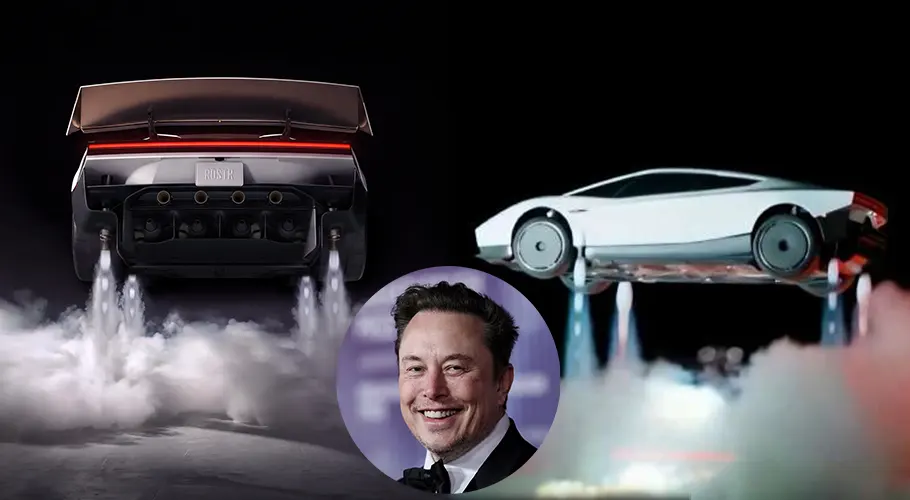
In another demonstration, the Roadster was shown launching off a ramp, rotating in mid-air and landing back on the ground. The manoeuvre was attributed to cold-gas thrusters, which release pressurised gas to generate force in a specific direction.
Tesla has outlined three versions of the vehicle: Performance, Thrust and Rocket. Reports indicate that the Rocket version sacrifices its second seat to accommodate additional gas tanks and thruster equipment.
According to technical analysis, upward-pointing thrusters do not necessarily improve a car’s performance on the road. By lifting the vehicle, they can reduce the load on its tyres and potentially compromise grip. Side-mounted thrusters, however, could provide additional lateral force while cornering, although further testing would be needed to establish whether they offer a meaningful performance advantage.
Can the Roadster Reach 97 km/h in Less Than One Second?
Tesla claims that the Roadster can accelerate from zero to 60 miles per hour (approximately 97 km/h) in less than one second. The company has also cited a time of 0.55 seconds for a specific version.
Tesla attributes this performance to a combination of thrusters, the suction system and a powertrain rated at more than one megawatt. However, these figures have yet to be independently verified through standardised testing.
Another important factor is the “one-foot rollout” measurement method. Under this convention, timing begins only after the vehicle has travelled its first foot. This can produce a lower recorded acceleration time than a measurement that starts from the vehicle’s initial movement.
Independent testing will therefore be essential to determine how the Roadster performs under consistent and comparable conditions.
Why Has the Claimed Range Dropped from 600 Miles to More Than 300 Miles?
When Tesla first unveiled the next-generation Roadster in 2017, it promised a range of 600 miles on a single charge. More recent information puts the vehicle’s projected range at more than 300 miles.
Tesla has not provided a definitive explanation for this change. The balance between a battery’s energy capacity and its ability to deliver power quickly can significantly affect a vehicle’s overall performance. Increasing power output may require a larger battery, potentially adding weight and cost.
The company has also cited a charging time of approximately 10 minutes to reach 80% from 15% on an 800- to 1,000-volt battery pack. However, the battery’s total capacity has not been disclosed.
Will the Rocket-Powered Roadster Be Legal on Public Roads?
The practical use of the Rocket version has raised several safety concerns. Gas discharged by the thrusters could propel dust, debris and small particles across considerable distances, potentially endangering nearby vehicles and pedestrians.
Other unresolved issues include the physical effects of extreme acceleration, the safety of manoeuvres performed in the air, the storage of highly pressurised gas and the risks associated with a collision.
Tesla has indicated that the Rocket version is not approved for public-road use. Its spectacular demonstrations should therefore not be taken as evidence that the vehicle can operate like a conventional road car in everyday traffic.
How Will Tesla Fare Against Its Global Rivals?
Tesla faces an increasingly competitive electric hypercar market. Vehicles such as the Rimac Nevera, Lotus Evija X and BYD Yangwang U9 Xtreme have already demonstrated impressive capabilities in speed, acceleration and track performance.
The new Roadster’s claimed capabilities are undoubtedly ambitious. However, its competitive standing will depend on independently verified acceleration and top-speed tests, track records and the performance of the final production model.
Ultimately, the demonstration highlights Tesla’s engineering ambitions, but turning the Roadster into a successful commercial product will require the company to substantiate its performance claims and address the challenges of safety, reliability and practical usability.
Until independent testing and production specifications become available, the Roadster’s most extraordinary capabilities should be regarded as claims awaiting verification rather than established real-world performance.