
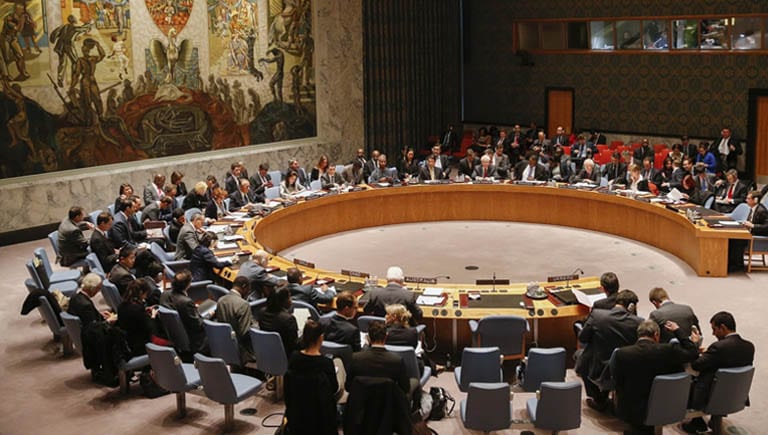
NEW YORK: The UN General Assembly elected on Wednesday four new non-permanent members of the Security Council for 2021 and 2022.
Canada lost a seat once again and the battle for the African seat will to a second round. India, Mexico, Norway and Ireland were chosen as non-permanent members.
Djibouti and Kenya both failed to receive the two-thirds vote majority required to win and will go to a second round of voting on Thursday.
Canada was beaten once again for one of the Western seats, by Ireland and Norway, despite a long campaign, a result likely to be a blow to Prime Minister Justin Trudeau.
In the Asia-Pacific region, India ran unopposed to win 184 votes out of the 192 countries that participated in the election. Mexico, which also ran unopposed, earned 187 votes.
The result means that India will now have a seat at the same table as China, just days after the two nations disputed their Himalayan border, trading blame for a brawl that left at least 20 Indian soldiers dead.
African nations have in the past picked their own candidate but were unable to put forward a single country this time. Kenya received 113 votes against Djibouti, which got 78.
Kenya boasts of enjoying the support of the African Union, but Djibouti says it should have the seat due to Nairobi’s past participation on the Security Council and the principle of rotation.
Djibouti and Kenya are both highlighting their roles in seeking peace on the Horn of Africa, as well as their contributions to UN peacekeeping options.
Kenya has pointed to its welcome to refugees from Somalia and South Sudan, as well as to its support to the two countries’ fragile governments.
Djibouti notes its strategic location and unusual role as a defense base for four countries – France, the United States, China and Japan – as well as its contributions in Somalia.
The competition was more customary for Europe and the Western seats. Canada was defeated in 2010 during its last bid for the Security Council, when the General Assembly chose Portugal instead.
This time it was dominated by Norway, with 130 votes, and Ireland, which had 128, the minimum number required to win.
Trudeau had invested heavily in the latest Security Council effort, with the defeat potentially causing him political embarrassment at home.
“As we move forward, we remain committed to the goals and principles that we laid out during this campaign,” Trudeau said in a statement, adding that Canada would “continue to play a vital role in advancing global cooperation and building a more peaceful, inclusive and sustainable world.”
Hoping to woo delegates, both Canada and Ireland had wielded star power: Celine Dion sang in New York City to promote Canada at the UN, while U2 performed a concert in the Big Apple for Ireland.
The General Assembly did not vote electronically, even though the United Nations is mostly operating virtually until the end of July due to the coronavirus pandemic.
Instead, each of the 193 delegations had a chance to cast a secret ballot at a designated time scattered throughout the day in the famous Assembly Hall. Each new Security Council member needed to win two-thirds of the votes cast.
The Security Council has 10 non-permanent members in addition to the veto-wielding Big Five — Britain, China, France, Russia and the United States.
The General Assembly also elected Turkish diplomat Volkan Bozkir as its president for the 2020-21 session on Wednesday.
Bozkir was the only candidate running but was opposed by Armenia, Cyprus and Greece due to historically tense relations with Turkey. This meant he could not be elected by consensus and nations had to cast votes.
ADVERTISEMENT