

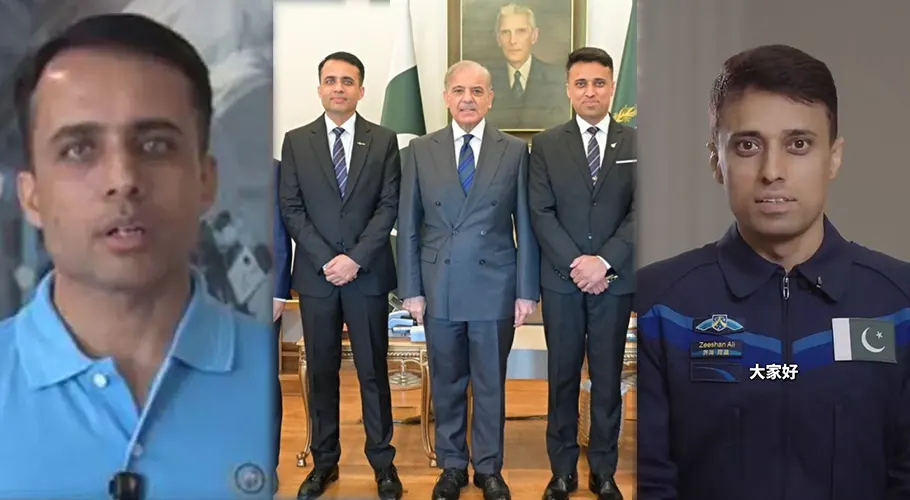
KARACHI: Pakistani astronaut Muhammad Zeeshan Ali has reached China’s Tiangong space station aboard the Shenzhou-24 spacecraft, marking a historic milestone for Pakistan’s space programme. He has become the first Pakistani to enter Earth’s orbit and the first foreign astronaut to board China’s Tiangong space station.
Ali, a Pakistan Air Force pilot, will participate in scientific research and experiments during his stay in space. Meanwhile, Commander Khurram Daud of the Pakistan Navy was selected as the backup astronaut for the historic mission.
The successful Shenzhou-24 mission represents a significant step forward in space cooperation between Pakistan and China. Ali was selected as the primary astronaut for the flight, while Daud served as his backup.
Who Is Muhammad Zeeshan Ali?
Muhammad Zeeshan Ali, 40, is a Pakistani military aviator associated with the Pakistan Air Force. He hails from Sargodha, Punjab, and was among two Pakistani candidates selected in April 2026 for astronaut training under a joint programme between Pakistan’s Space and Upper Atmosphere Research Commission (SUPARCO) and the China Manned Space Agency (CMSA).
Following his selection, Ali underwent approximately seven months of specialised training at China’s astronaut training facilities.
His training covered spacecraft systems, different phases of spaceflight, emergency response procedures, physical conditioning and scientific research operations.
Learning the Chinese language was also an important part of the programme, enabling him to communicate effectively with Chinese astronauts and carry out his assigned duties aboard the space station.
What Will Zeeshan Ali Do at the Space Station?
Muhammad Zeeshan Ali is expected to spend approximately one week aboard the Tiangong space station, where he will participate in scientific experiments and research activities.
More than 300 research proposals were submitted by Pakistani universities and research institutions for the mission, of which four collaborative research projects were selected.
These projects cover areas including biotechnology, food security, climate change and the behaviour of biological systems in the space environment.
One of the experiments involves photosynthetic cyanobacteria, microscopic organisms that could potentially contribute to food and oxygen production during future long-duration space missions.
It is important to note that Ali is serving as a payload specialist rather than the spacecraft’s pilot or commander. His primary responsibility is to conduct scientific experiments and support research activities in orbit.
Who Is Khurram Daud?
Khurram Daud, the second Pakistani astronaut candidate selected alongside Muhammad Zeeshan Ali, hails from Hyderabad, Sindh. He is an experienced military aviator associated with Pakistan Navy aviation and has served in maritime aviation operations.
During his military career, Daud operated the P-3C Orion aircraft as a pilot and mission specialist. The aircraft is designed for long-range maritime surveillance and anti-submarine warfare operations.
In February 2019, amid heightened tensions between Pakistan and India, Daud reportedly played a key role in an operation involving the detection and tracking of an Indian Navy submarine near Pakistani territorial waters.
In recognition of his operational performance, he was awarded the Tamgha-i-Basalat by President Arif Alvi in August 2019.
His extensive aviation experience, including exposure to demanding operational environments, high-speed flight and physically challenging conditions, also contributed to his preparation for the rigorous requirements of astronaut training.
What Is Khurram Daud’s Role in the Space Mission?
In April 2026, Muhammad Zeeshan Ali and Khurram Daud were selected for specialised astronaut training in China under the Pakistan-China human spaceflight cooperation programme.
Both candidates underwent extensive preparation covering spacecraft systems, emergency procedures, weightlessness training and other technical aspects of human spaceflight.
Following the training and selection process, Ali was chosen as the primary astronaut for the Shenzhou-24 mission, while Daud was designated as the backup astronaut.
Although Daud did not take part in the actual spaceflight, he remains an important member of Pakistan’s human spaceflight programme. His military aviation experience could prove valuable in preparing and training future Pakistani astronaut candidates.
Why Is This Mission Important for Pakistan?
Muhammad Zeeshan Ali’s arrival at the Tiangong space station marks a significant achievement in Pakistan’s space exploration efforts.
The mission not only gives Pakistan a place in human spaceflight but also creates opportunities for scientific research, technological advancement and deeper international cooperation.
The joint mission reflects the growing scientific and technological partnership between Pakistan and China, particularly in the field of space exploration.
Before Ali’s historic orbital journey, Pakistani-origin woman Namira Salim travelled to space in 2023 aboard Virgin Galactic’s commercial spaceflight mission. However, Ali is the first Pakistani to enter Earth’s orbit and reach a space station.
His achievement is expected to inspire young Pakistanis, particularly students interested in science, technology, engineering and space research, and encourage greater participation in the country’s emerging space sector.