
KARACHI: Pakistan Peoples Party (PPP) Chairman Bilawal Bhutto Zardari spoke at length about the country’s political system, constitutional reforms, provincial autonomy and the creation of new provinces during his address at the Karachi Press Club. However, his remarks have also brought renewed attention to the PPP’s 18-year rule in Sindh and questions about the provincial government’s performance.
The central question is whether Bilawal Bhutto Zardari, who has raised concerns about shortcomings in the country’s political system, will also address the record of his party’s nearly two decades in power in Sindh.
The PPP has governed Sindh continuously since 2008. During this period, responsibility for education, healthcare, clean drinking water, sanitation, employment and basic public services has rested largely with the provincial government. However, available official and international data point to persistent challenges across several key sectors.
7.8 Million Children Out of School in Sindh
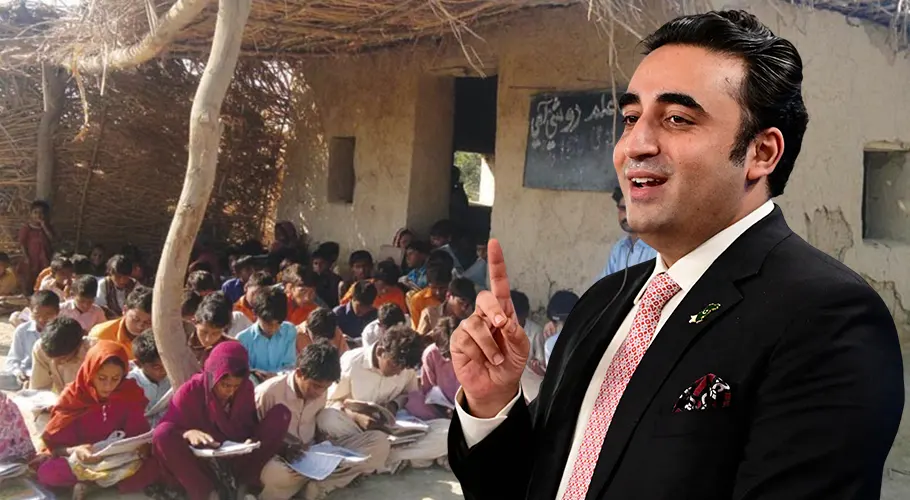
Education remains one of the most pressing challenges facing the province. According to the provincial report of the Pakistan Bureau of Statistics based on the 2023 census, 7,818,248 children aged between five and 16 were out of school in Sindh, accounting for 46.29 per cent of the population in that age group.
UNICEF, meanwhile, estimates that approximately 7.4 million children in Sindh are not attending school, representing around 44 per cent of the relevant age group.
The figures highlight the scale of the province’s education crisis, with millions of children still deprived of their basic right to education.
In 2013, the Sindh government passed the Sindh Right of Children to Free and Compulsory Education Act, making free education a legal entitlement for children aged five to 16. Yet, more than a decade later, millions remain outside the education system.
Billions Spent on Education Projects, Yet Schools Remain Incomplete
Delays in education infrastructure projects have also raised concerns about the use of public funds.
According to the Auditor General of Pakistan’s Audit Report for 2024-25, more than Rs2.4726 billion was spent on the construction, rehabilitation and renovation of schools. However, several projects remained incomplete even after delays ranging from three to 16 years.
The audit report noted that these delays had deprived students of improved school buildings and essential facilities. It also sought explanations from the relevant authorities regarding the reasons for the delays and the utilisation of allocated funds.
This raises questions about why basic improvements in public schools have taken so long despite the PPP’s prolonged tenure in power.
Healthcare, Clean Water and Urban Services Remain Major Challenges
Education is not the only sector facing difficulties in Sindh. Healthcare, access to safe drinking water, sanitation, drainage, waste management and public transport also remain significant challenges in Karachi and other urban and rural areas.
A 2025 audit report by the Office of Inspector General of the US Agency for International Development (USAID) highlighted shortcomings in selected schools in Sindh, including a lack of drinking water, inadequate toilet facilities and poor maintenance of school buildings. The report noted that insufficient maintenance after the handover of school facilities had affected the learning environment.
Separately, a Dawn editorial published in August 2026 reported that 14,343 schools damaged by the 2022 floods in Sindh were still awaiting rehabilitation as of March 2026.
After 18 Years in Power, What Has Sindh Gained?
During his address, Bilawal Bhutto Zardari called on the federal government to ensure the provinces receive their due financial resources, uphold the National Finance Commission (NFC) Award and implement the 18th Constitutional Amendment.
However, provincial autonomy also comes with accountability, a fundamental principle of democratic governance.
While provincial governments are entitled to demand their constitutional and financial rights from the federation, they must also explain how available resources have been utilised to improve education, healthcare, access to clean water and other essential public services.
After 18 years in power, the PPP faces questions not merely about its political commitments but also about its performance on the ground. The large number of out-of-school children, long delays in completing education projects and continuing problems with basic public services have brought the provincial government’s priorities under renewed scrutiny.
As Bilawal calls for political and democratic reforms at the national level, a question continues to confront his party at home: why have the promised improvements in education, healthcare, clean drinking water and basic civic facilities remained elusive in Sindh after nearly two decades of PPP rule?