

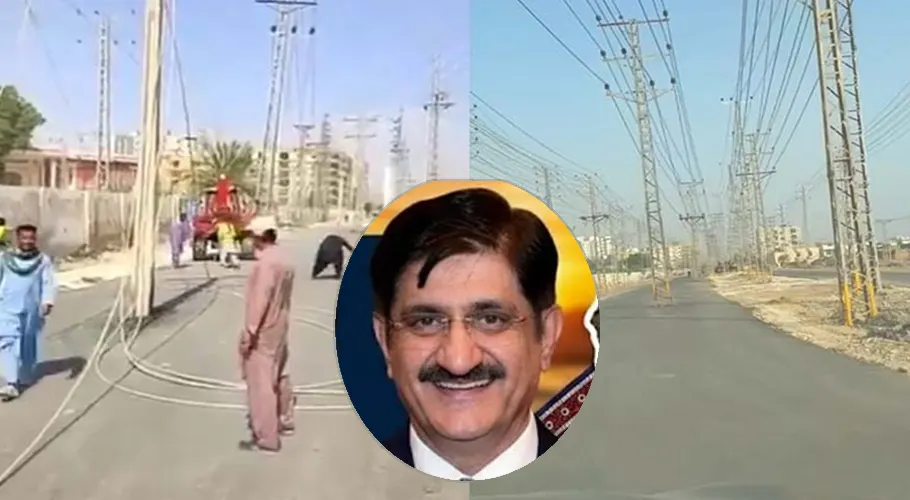
KARACHI: The governance and development planning of the Pakistan Peoples Party (PPP), which has been in power in Sindh for nearly 18 years, has once again come under scrutiny following a controversial road project in Hyderabad, where a road was constructed without first removing electricity poles standing in its path.
After facing criticism from social media users and television news channels, Sindh Chief Minister Murad Ali Shah offered an explanation but placed the responsibility for the delay on the Hyderabad Electric Supply Company (HESCO), rather than acknowledging possible shortcomings in the government’s planning and coordination.
Speaking to the media in Karachi, the chief minister said the chief secretary had facilitated the acquisition of land from the Cantonment Board for the road project. He added that HESCO had also been paid to relocate the electricity poles, but the utility failed to remove them on time.
According to Murad Ali Shah, the government decided to proceed with road construction first in order to put pressure on HESCO to complete the relocation work.
He claimed that following media coverage of the issue, HESCO removed 25 electricity poles within a single day.
However, the chief minister’s explanation has raised several questions about the planning and execution of the project. If removing the electricity poles was a necessary step, who authorised construction to begin before their relocation? Was there a lack of coordination between the departments concerned, or were proper monitoring and oversight missing?
Moreover, if HESCO had already received payment for relocating the poles, why was the matter not resolved before construction began?
Failed Planning or a ‘Grand Plan’?
Interestingly, Murad Ali Shah described the entire approach as part of his government’s strategy and a broader ‘grand plan’.
However, critics question how a project in which electricity poles remained standing in the middle of a newly constructed road can be presented as an example of effective planning.
The issue also triggered strong reactions on social media, with users criticising the PPP-led provincial government. Television news channels also raised questions about the project’s planning, coordination and supervision.
Meanwhile, a HESCO spokesperson had maintained that the utility provides designated markings before road construction and that the electricity poles should be relocated before construction work proceeds.
The spokesperson also questioned why the relevant departments had completed the road construction before the poles were removed.
The controversy has now raised a broader question: who will take responsibility for the administrative lapses surrounding a project that was supposed to improve travel facilities for the people of Hyderabad?